
Non-alcoholic fatty liver disease (NAFLD)
Nonalcoholic fatty liver disease (NAFLD) is becoming the most common cause of chronic liver disease in the developing world, found in 17-30% of the population in Western countries and 2-4% worldwide. NAFLD is diagnosed predominantly in the fourth through sixth decades of life, although the childhood obesity epidemic has caused an increase in the rate of pediatric NAFLD. The prevalence of NAFLD varies by ethnicity, affecting ~45% of Hispanics, 33% of Whites, and 24% of Blacks. Among Whites, NAFLD is more common in men than in women but not in other racial background (Angulo, P. (2007)).
Alcoholic Fatty Liver Disease (ALD):
In order to compare the genetic or clinical results between non-alcoholic and alcoholic fatty liver disease, we will also collect individuals with alcoholic fatty liver condition using available ICD-9 code:


Comments
SGOT/ AST
Some labs report SGOT, some report it as AST
Please leave blank the one that your lab does not use.
DD for NAFLD_DataDictionary_CovLab_v4.csv
Questions.
1. If all units in the Labs v4 DD shoudl be u/dl, what Bilirubin should be?
2. For bilirubin, We need to collect? total bilirubin? conjuated? or unconjuated?
Thanks !
DD for NAFLD_DataDictionary_CovLab_v4.csv
1). If all units in the Labs v4 DD shoudl be u/dl, how about bilirubin?
2). For bilirubin, do we need to collect total bilirubin ? conjuated ? unconjuated ?, or all of the 3?
thanks !
Total Bili please
Please provide Total Billirubin
NAFLD_DataDictionary_demographics_v2.csv
Question: data defined in this sheet only has the following cases (see below) but does not include case #4 which is Alcohol dependence without any liver disorder and Control.
1=Case1_NAFLD;2=Case2_NAFLD;3=Case3_ALD
Question, If we provide data, can we denote "Alcohol dependence without any liver disorder" as "4" and Ctl as "0"?
Thanks !
case is missing (.)
Other item is correct
Alcohol dependence without any liver disorder" as "4"
NAFLD_DataDictionary_HxVistsDx.csv
Question, there are very few patients who missing data for heights or weights, what we should put over the data sheet, using '.' or '..' because the DD does not specify this situation.
A few LOINC mapping differences
I found a few LOINC mapping differences at our site on which I wanted to get your approval before I included the values. They have the same units (U/L) and are also from serum.
For AST, we use 30239-8 Aspartate aminotransferase [Enzymatic activity/volume] in Serum or Plasma by With P-5'-P
For ALT, we use 1743-4 Alanine aminotransferase [Enzymatic activity/volume] in Serum or Plasma by With P-5'-P
For LDH, we use 14804-9 Lactate dehydrogenase [Enzymatic activity/volume] in Serum or Plasma by Lactate to pyruvate reaction
If I use only the LOINC values that you provided I only find a very small amount of labs for these types. Is this ok?
LOINC Codes
If your LOINC codes don't match, its ok. Those are just a guideline. If you have alternate mappings for AST labs, for example, please use what you have.
for Activity score
Hello,
We are unable to find any NAFLD activity score in any cases, either in the clinical notes or in the pathology reports, using terms provided in the DD. Do you have any suggestion or alternative terms that we shall use for the algorithm?
Thanks,
Zi (Carol)
Terms and score
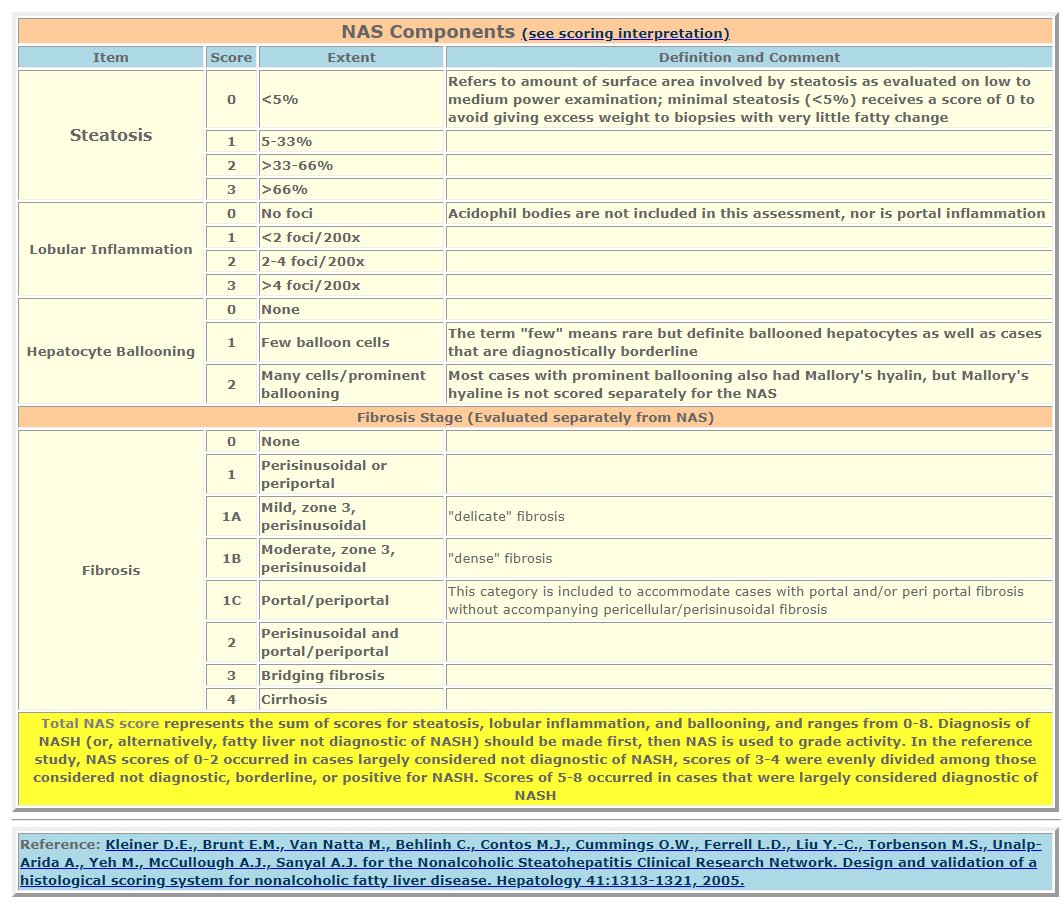
So you looked at the terms in the algorithm? Table three can help find the score (which is NASH or NAFLD Activity Score).
Does that help?
Are you looking in all notes, or just pathology notes?
A question for LOS
Hello,
When we intended to calculate LOS, we found 196 types of encounters in our EMR. Do you have a general guidance that which type of encounter we shall exclude?
Thanks,
Zi (Carol)
LOS
LOS is intended for inpatient encounters. Does that help? I doubt all 196 types will be present in the patient data for this phenotype.
Keywords used for finding scores
In our data, the score is recorded as (for example): The NAFLD activity score (NAS) is 3 (2+0+1).
Key words we used for finding relevant NAS score are "NAFLD" OR "NAS" OR "activity score” OR "NAFL" OR "NASH" OR "fatty liver" OR "activity score".
Fibrosis stage is recorded as (for example): stage 2 fibrosis.
Are pseudo code and data dictionary up to date as of 4/24/2018?
There has been a lot of good discussion here. Are the pseudo code document and data dictionary currently posted on PheKB up to date as of 4/24/2018? In other words, if we follow those documents can we ignore the discussions posted above?
Thanks!
David
Hi David,
Hi David,
Yes all of the documents are current. Both the nas-histology-modified.xlsx and nafld_pathology_NAS_score.png can be used to manually grade the pathology reports and fill in the NAS scores.
Wonderful!
Wonderful!
algorithm doc and 1 DD NOT updated based on questions on PheKB
as of today, the algorithm doc does not contain all the necessary updates based on all the comments I've read on PheKB:
i.e.,
Case 1 & 2 criteria are "AND" criteria, i.e., all 3 criteria must be met for ea., i.e. NLP is required to be case 1 or 2, correct?
Table 1: TPN Dx are only excluded if the occur in the 365 days before first NAFLD Diagnosis code?
Table 4: does NOT contain the same diagnoses and procedures as the corresponding data dictionary NAFLD_DataDictionary_CovDx_v2.csv, please clarify in both the document and the data dictionary which codes to use, and which are ICD-9 & 10 diagnoses, vs. ICD-9 & 10 procedures, vs. CPT codes.
Table 5: should not have ALP & GGT listed, & SGOT should be listed, & SGOT is the same as AST?
Please update the document and the NAFLD_DataDictionary_CovDx_v2.csv Data Dictionary so that it is clear, I need to be sure I'm doing the right things.
thank you!
revision
Sorry for the confusion algo document is updated.
yes, AST/SGOT are the same, but there are different entries in the caDSR. Please use whatever you your system records for each lab result (either AST or SGOT) for the Covariate Lab DD. (updated to v5)
TPN within a year of NAFLD diagnosis could indicate some other nutritional deficit. So, correct, only exclude if the TPN happens in the year prior to the NAFLD diagnosis.
Current Cov_DX DD is updated to v3.
diagnoses in table 4 vs. DD ...CovDx_v3 & ICD-9 code for T2DM
2 questions:
1) for T2DM, ICD-10 E11.* is listed which encompasses all codes for T2DM, but only 1 corresponding ICD-9 code is listed (250.00), did you intend to instead include 250.x0 & 250.x2, which would be all the ICD-9 codes for T2DM?
2) Some of the diagnoses in Table 4 still aren't listed in the DD ...CovDx_v3.csv, should I just refer to Table 4 for that DD?
Thanks,
Jen
1) just 250.00 please. thanks
1) just 250.00 please. thanks.
table 4 vs. covar DD?
and Q2 was do I use codes listed in table 4 or in covar DD, for that DD (table 4 has more listed)?
should be updated to v4
should be updated to v4
What does the term "activity score" represent in the NLP task?
Hi,
Can you please describe what the term "activity score" is intended to represent (what is its meaning) in the NLP task? Some of our reports discuss "activity" in the liver, but the term "activity score" does not appear.
Thanks,
David
Activity score is the same as
Activity score is the same as a NAS score. See the nafld_pathology_NAS_score.png grading document for a full explanation.
What does "NAS" represent in the NLP task?
Hi. Same question as above for "NAS" -- what does it mean in this context. We do not see it in our reports.
Thank you,
David
NAS
NAS stands for non-alcoholic steatosis (NASH is non-alcoholic steatohepatitis)
See Table 3 in the algorithm
See Table 3 in the algorithm document for text.
Exact ICD diagnosis codes for cases 1 & 2?
ICD-9:
571.5, 571.8, 571.9
ICD-10:
K75.81, K76.0, K76.9
I ask b/c the document says "*571 is different from 571.0," so I'm not sure if I'm supposed to inc. 571.0 & 571
and it says "non-specific" for K76.0, K76.9
571.0 not 571
571.0 not 571
use 571.0 for case types 1 & 2
So do I use 571.0 for case types 1 & 2?
Jen
571.0 for ALD CASE
never mind to my last question RE: case diagnoses, I answered myself, I see now that ALD (case type 3) is diagnosis 571.0, not NAFLD case types 1 & 2
types of imaging for case type 1?
for case type 1, it says to look for evidence "by imaging or by hiostology";
What type of imaging should we use : abdominal ultrasound, CT scan, &/or MRI reports?
any of the above
any of the above
"clinical notes" = progress notes? & which subjects in score DD?
2 more questions:
1) by "clinical notes" do you mean just progress notes from in person clinical encounters, either outpatient office visits or inpatient hospital stays, or do you mean all notes in the EHR, or something else?
2) We are assuming the only subjects' records that are to be in the score data dictionary data file are those dates with positive mentions of any of the phrases in Table 3, even if we can't find any scores or parts of scores (in which case we leave teh score fields as missing '.', but date & subject ID will be there so you know every time a subject had a mention of NAFLD or related phrases). Is this correct?
thanks! Jen
1) Primarily pathology
1) Primarily pathology reports. But some sites have indicated other notes can be relevant. Please start with pathology report notes.
2) correct, thank you.
case type 1 vs. 2: "biopsy rpt" vs. "clinical notes"
I asked about "clinical notes" b/c that appears to be what differentiates between case type 1 & 2, is that correct, i.e. I see the only difference between case types 1 & 2 being the NLP in step 3 (i.e., steps 1 & 2 are the same for those 2 case types), where step 3 for both case types is to find "Evidence of hepatic steatosis" but to use NLP of different text :
for case type 1, step 3 says NLP "...by imaging or by histology in biopsy report"
vs. for case type 2, step 3 says NLP "... in clinical notes"
Can you please clarify if this is the difference between case types 1 & 2, & if so, then what is meant by "clinical notes" (assuming biopsy rpt. & pathology rpt. are the same thing)?
OR if we are to just use pathology reports and not worry about case type 2?
Thanks! Jen
Case 1 vs Case 2
Yes the clinical note vs biopsy report/pathology report is the critical distinction.
Patients could overlap, of course. But Primary is Case 1. So if a patient meets part 1 and part 2 of the case definition, but doesn't have any pathology reports, then procede to case 2, part 3 (clinical notes), if those are available.
Pages